Your Experience Is the Point: How Trades Workers Find the Right AI Tools
AI doesn’t make you more valuable by replacing what you know. It makes you more valuable because of what you know.

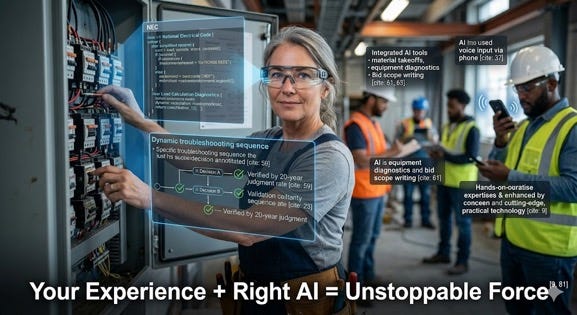
Here’s something the tech world gets wrong about the trades.
They talk about AI like it’s a replacement engine — something that does the thinking so the worker doesn’t have to. That framing might make sense in some industries. It doesn’t make sense when you’re running conduit through a finished ceiling, diagnosing a refrigerant leak, or reading a set of plans for a complicated framing situation.
In those moments, there is no workaround for knowing what you’re looking at.
What AI actually is — when it’s the right tool, used the right way — is a force multiplier on top of experience you already have. It handles the repetitive, the administrative, the time-consuming lookups. You handle the judgment calls. The two working together are more capable than either one alone.
The key word is right tool. Because not every AI tool is built for trade work, and picking the wrong one wastes time and builds distrust. Here’s how to think about finding what fits.
Why Experience Comes First
Before we talk about tools, let’s be clear about something.
A first-year apprentice and a 20-year journeyman can use the exact same AI tool and get completely different outcomes. The difference isn’t the tool. It’s the judgment sitting behind it.
When an experienced electrician asks an AI about a troubleshooting sequence, they already know which answers make sense and which ones don’t. They can catch when the AI is giving them a textbook answer that doesn’t account for real-world conditions. They know what follow-up questions to ask. They know when to stop trusting the output and go back to their own read of the situation.
That filtering instinct — built from years of being wrong on job sites and figuring out why — is not something AI has. It’s something you have. And it’s what makes you the most important part of any human-AI workflow in the trades.
AI gets you to the answer faster. Your experience tells you if the answer is right.
What to Look For in an AI Tool
Not all AI is the same. There are general-purpose tools, trade-specific platforms, and everything in between. Here’s a practical framework for evaluating what’s worth your time.
Does it understand your language? Trade work has its own vocabulary — not just technical terms, but the shorthand, the part numbers, the way you’d actually describe a problem in the field. A good AI tool for trades work should be able to follow a description like “two-pole 20-amp breaker keeps tripping on an HVAC circuit, not overcurrent, more like a thermal issue” without needing everything defined. If you have to translate your knowledge into plain English every time, the tool is creating friction, not reducing it.
Does it know when to say it doesn’t know? This is the big one. An AI tool that gives you a confident wrong answer is more dangerous than one that says, “I’m not certain — you should verify with your local code.” In trade work, confident wrongness can mean failed inspections, callbacks, or worse. Look for tools that flag uncertainty rather than paper over it. Test this deliberately — ask a question you already know the answer to and see if the tool hedges appropriately or bluffs.
Is it built for your workflow or against it? Some tools are built for office workers sitting at a desk. That’s not where trade work happens. Look for tools you can use on a phone, in a noisy environment, with a quick question and a quick answer. Voice input helps. Short response formats help. Tools that require you to set up an account, fill out a profile, and navigate a dashboard before you get an answer — those belong in the office, not on the job site.
Does it save your actual time? Be honest about where your time actually goes. For some tradespeople it’s bid writing. For others it’s scheduling, customer follow-up, parts ordering, or permit paperwork. The right AI tool is the one that cuts into your specific friction — not the one with the most features. A tool that’s genuinely useful for two things is worth more than one that’s mediocre at twelve.
Is your experience protected?
There are two broad categories worth understanding.
General-purpose AI assistants — ChatGPT, Claude, Microsoft Copilot — are like a highly capable apprentice who’s read everything but hasn’t been on a job site. They’re strong for writing, explaining, reasoning through problems, and handling administrative tasks. Their trade knowledge is broad but not deep. They work best when you already know enough to guide the conversation and catch errors.
Trade-specific platforms in the tasks you already do. These tools tend to require less hand-holding because they already understand the context you’re working in.
The practical answer for most trades workers is both. Use a general AI assistant for the one-off questions, proposals, and communications. Use trade-specific platforms for estimating, scheduling, and project management. They serve different purposes and they’re not in competition.
The Questions Worth Asking on Your Trade
Electrical: Code lookups, load calculation double-checks, troubleshooting sequences for unusual symptoms, bid scope write-ups, apprentice training questions. The NEC is dense and AI navigates it faster than flipping pages — but you still need to know what you’re looking for.
Plumbing and HVAC: — AI fills that gap while you wait.
Carpentry and Construction: Span table lookups, material takeoffs, permit scope descriptions, sequencing and phasing complex jobs, communicating schedule changes to customers and subs. The paperwork side of construction is where AI consistently earns its keep.
Red Flags Worth Watching
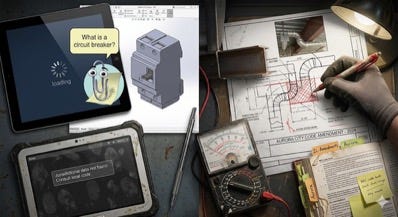
A few patterns that should make you skeptical of any AI tool pitched at trade workers.
It promises to eliminate field decisions. — and these tools reduce that friction better than anything that’s come before.
The tradespeople who figure that out early aren’t going to be replaced. They’re going to be faster, more organized, and more competitive. They’re going to write better bids, respond to customers quicker, find the right code reference in 30 seconds instead of 20 minutes, and go home a little earlier.
The ones who will struggle are the ones who either refuse to look at it at all, or who use it without their own judgment in the loop.
Neither extreme works. The middle — experienced professionals using the right AI tools as a practical part of how they work — is where the value actually lives.
You spent years building the knowledge that makes you effective in the field. AI doesn’t make that investment worthless. It makes it worth more.
The best place to start: pick one task you find genuinely tedious — bid writing, code lookups, customer emails — and spend one week using a free AI tool for just that. Let the results tell you whether it belongs in your belt.
Disclaimer: This article was collaboratively written by Michael T. Mantzke, Anthropic’s Sonnet 4.6, and Gemini tools as an AI assistant coupled with the Authors extensive industrial experience. AI contributed by drafting and organizing ideas, creating the stock image, while the human authors prompt engineered the content and ensured its accuracy and relevance.
About the Author; Michael T. Mantzke, CEO, is with Global Data Sciences, Inc. (GDS), headquartered in Aurora, Ill. GDS identifies and resolves known and unknown inventory problems that reduce customers’ headaches and increase their profits. Areas of expertise include global operations, data analytics, end to end inventory management, process and procedure optimization, EDI (Electronic Data Interchange) systems integration and optimization.